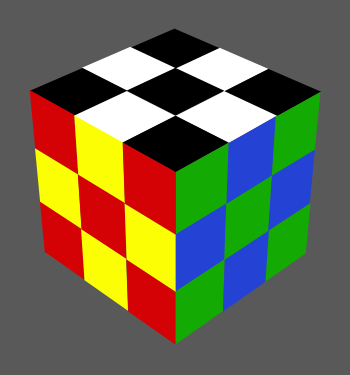
Opponent Process
Six colors. No orange. Every pair easier to tell apart.
Replace orange with black. We measured the plastic of real cubes and scored every color pair. On every standard cube the closest pair is red/orange. OP removes it.
Compare cubes ↓The problem in one picture
On every standard cube we measured, red/orange is the closest pair.
Why all 15 pairs matter
On a solved cube red sits opposite orange, so they never touch. On a scrambled cube any color can touch any other. Six colors make 15 possible pairs, and you read all of them during a solve.
So we score every pair. The grid below shows all 15 for the GAN V100 Matte standard palette. Darker cells are closer pairs, and the closest pair is outlined.
What the numbers mean
Scores are distances in CAM16-UCS, a model of color vision published by the CIE (the international color-standards body). Each color becomes a point in a space whose three directions are lightness, colorfulness and hue. The distance between two points (written ΔE′) is how different the two colors look to a person, not how different their RGB numbers are. About 1 is the smallest difference you can see side by side. Bigger is easier to tell apart.
Why not ΔE2000?
ΔE2000 was designed for tiny differences, such as checking that two batches of paint match. It under-counts differences in colorfulness. White vs yellow is almost all colorfulness, so ΔE2000 rates GAN's white/yellow as about the same as red/orange . CAM16-UCS was built and tested for large differences. It separates them: vs .
Viewing condition
All scores use one viewing condition: adapting luminance LA = 64 cd/m², background Yb = 20, average surround. That's a normally lit room. Numbers can only be compared with each other under the same condition. Brighter or dimmer light changes them a little.
Compare cubes
Each palette is six colors measured from one real cube. Worst pair is the score of the closest two colors. Whole-cube adds up all 15 pair scores. Higher is better for both.
OP Advantage Comparison
Pick a cube. We measured its orange and its black, so we can score the same plastic both ways: the standard scheme, and Opponent Process with black in place of orange.
Compare Multiple Cubes
Line up any of the measured palettes, from any cube, and sort them by either score.
What colorblind cubers see
How many cubers is that?
About 8% of men and 0.5% of women have red-green color vision deficiency (protan + deutan, populations of European descent; somewhat lower elsewhere). Speedcubing is mostly male, so roughly 7 in every 100 people at a competition have it, about 20 at a 300-person comp. About a quarter of them are protan, for whom orange and green on a standard cube look nearly the same.
What the data does not show: how many people have quit cubing, or would start, because of it. Nobody has that number.
The simulations model the severe form (a missing cone). Milder, more common forms (for example deuteranomaly, ~5% of men) see something between the normal and simulated columns.
Build your own palette
Pick six colors: type a hex code, use the color picker, or choose any of the measured colors (including special editions). Scores update as you go.
Scores for typed hex codes describe the color as specified on a screen. Scores for measured colors describe the actual plastic.
Two ways to score
Worst pair the analyst's view
Recognition fails at the closest pair, so that pair is the cube's rating. A big sum can hide one bad pair that keeps getting confused.
Sort the table by worst pair →Whole-cube Andy's view
Contrast adds up. A cube whose pairs are wider on average reads faster in hand. That's what years of solving on these cubes feels like.
Sort the table by whole-cube →Both rankings put OP palettes at the top. They only disagree in the middle of the table.
For colorblind observers the worst pair is the right measure. If two colors look the same, the other 14 pairs don't help.
Videos
Method, caveats, downloads
How it was measured
- Nix Mini 3 spectrophotometer, M2 mode (UV excluded), D50 illuminant, 2° observer, 45/0 geometry, 13 mm spot.
- Faces measured in place on assembled stickerless cubes. Each OP palette uses that cube's own black plastic.
- Lab (D50) → CAT16 → CAM16-UCS. Colorblind views use Machado, Oliveira & Fernandes (2009) at full severity, applied before CAM16.
- The site's numbers are computed live in your browser and match the published report to ±0.1.
Caveats
- The 13 mm spot is bigger than small facelets, so some light from chamfers and neighboring pieces is included. Publication-grade numbers will come from disassembled pieces on a black backing.
- "Black" here is each stickerless cube's body plastic. A production OP cube would have a proper black facelet color that could be tuned.
- On-screen colors are approximate. Very saturated yellows and greens are outside what a normal screen can show (marked ◐), so they look slightly duller than the plastic. Scores use the measured values, not the screen color.
- The tritan simulation is the least reliable of the three; its authors call it approximate.
- Recognition speed is not measured yet. Contrast is necessary for fast recognition, not proof of it. A timed recognition test is the planned next step.
- The Kanyon cube is left out of the comparator as an outlier. Its colors are available in Build your own.
Downloads
- cubes.json — 115 measured colors, 16 cubes (Lab D50 + sRGB)
- palettes.json — the 21 palettes
- Summary CSV · All pairs CSV
- Full numeric report · Plain-English briefing
- cube_contrast.py — the original Python analysis
- CubeContrast.gs — Google Sheets functions, same math
- cam16ucs.js — the JavaScript module this page uses
- Raw Nix export